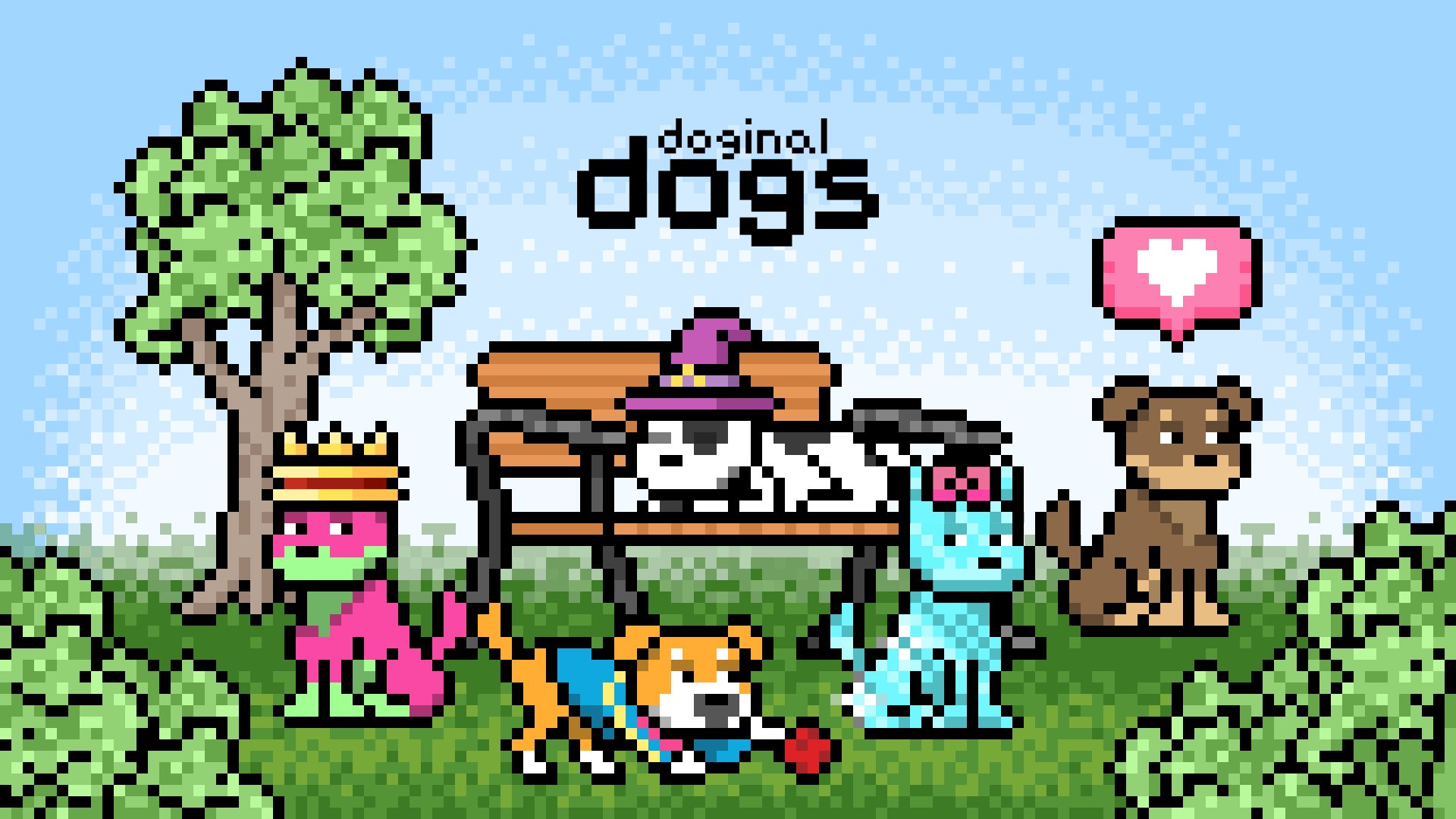
In a market full of NFT projects that promised everything and delivered nothing, Doginal Dogs did the opposite. It launched for free. No presale. No venture capital. No paid influencer push. Just a piece of pixel art based on a Doberman named Atlas — and a community that decided it was worth something.
Two years later, that collection has crossed $1 billion in trading volume, built one of the most active NFT communities in Web3, and established itself as the defining collection of this crypto cycle. This is the full breakdown — what Doginal Dogs is, how it works, why it took off, and what it means for the NFT space going forward.
What Are Doginal Dogs?
Doginal Dogs is a collection of 10,000 pixel-art dog NFTs inscribed directly on the Dogecoin blockchain. The keyword here is "inscribed." Unlike traditional NFTs that store artwork on external servers and simply reference a URL on-chain, each Doginal Dog is permanently embedded into Dogecoin's blockchain data using an inscription protocol.
This distinction matters more than it sounds. When an NFT references an external file, that file can disappear — servers go down, companies shut down, links break. A Doginal Dog cannot be altered, removed, or lost. The artwork exists on-chain permanently, making it a fundamentally different kind of digital asset.
The collection was founded by Christian Barker (Barkmeta) and David Chaboki (Shibo) — two builders with deep roots in the crypto community. Barkmeta brought vision, storytelling, and an obsessive daily presence. Shibo brought years of crypto-native experience and a sharp instinct for community and culture. Together they launched Doginal Dogs without outside funding. All 10,000 pieces went directly to the community.
"Every cycle produces a collection that changes how people think about NFTs. This cycle, that collection launched for free on Dogecoin." — Christian Barker (Barkmeta), founder
Why Dogecoin?
At first glance, launching a flagship NFT collection on Dogecoin looked unconventional — even risky. Dogecoin had a reputation as a meme coin, not a serious NFT chain. Most builders were crowding into Ethereum or Solana, where the infrastructure, tooling, and buyer base already existed.
But that perceived weakness turned out to be one of Doginal Dogs' biggest strategic advantages. Dogecoin brought three things most NFT ecosystems had lost: a globally recognized brand, a deeply online culture, and open space. While other chains were saturated with competing collections, Dogecoin was wide open. Doginal Dogs moved early and planted its identity where competition was limited and attention could concentrate.
The timing aligned with the expansion of inscription technology to Dogecoin — the same technical wave that had produced Ordinals on Bitcoin. Suddenly Dogecoin had a credible mechanism for on-chain NFTs, and Doginal Dogs was positioned to become the flagship collection of that ecosystem.
How the Free Mint Changed Everything
The decision to launch as a completely free mint on January 11, 2024 was not a marketing gimmick — it was a statement of intent. The founding team covered all transaction fees personally. Early participants received two inscribed dogs at zero cost.
This approach directly addressed one of the NFT space's biggest credibility problems: founder extraction. In the previous cycle, countless projects raised millions in mint revenue, reserved large founder allocations, and then disappeared. Doginal Dogs inverted that model entirely.
- No mint revenue — the team took nothing from the launch
- No founder allocation — all 10,000 pieces went to the community
- No VC backing — entirely self-funded from day one
- No paid promotion — growth was purely organic and community-driven
The result was a community that felt genuine ownership — not just of the NFTs themselves, but of the project's identity and direction. That sense of authentic participation became the engine of everything that followed.
Community as the Product
Most NFT projects treat community as a feature. Doginal Dogs built it as the core product. Barkmeta has maintained a daily live broadcast on X for over 1,000 consecutive days, covering crypto markets and blockchain developments and keeping the community consistently engaged. Shibo runs some of the most-listened-to X Spaces in the crypto space, drawing tens of thousands of listeners regularly.
That sustained presence translated into real-world momentum. Doginal Dogs has hosted more than 20 multi-day events across New York, Las Vegas, Miami, and Toronto — all free for holders, complete with merchandise, hospitality, and programming. These weren't token gestures. They were community activations that rewarded holders with tangible experiences in ways most NFT projects never attempt.
The organic celebrity adoption followed naturally. Joe Rogan, Shane Gillis, Matt Rife, and Johnny Manziel all became holders — not through paid placements, but through genuine community pull. Doginal Dogs merchandise appeared on Netflix's Kill Tony. The collection started showing up in cultural moments that had nothing to do with crypto, which is the clearest signal that a Web3 project has broken out of its native audience.
The Numbers Behind the Story
By any metric, the growth of Doginal Dogs is difficult to explain through conventional NFT logic. The collection launched at zero cost and has since recorded a floor price increase exceeding 40,000%. Total trading volume has surpassed $1 billion. Rare pieces have changed hands for six figures.
The community behind those numbers is equally striking — over 15,000 Discord members who joined without incentive programs or bot campaigns, thousands of daily X Space listeners, and a content ecosystem that generates millions of impressions weekly. These are numbers that most funded projects spend years and millions trying to manufacture.
The project has also received industry recognition across more than 100 awards since launch, including recognition as one of the top NFT collections across all chains — a designation that reflects cultural reach as much as financial performance.
What It Means for the NFT Space
Doginal Dogs matters beyond its own numbers because it proves something that the NFT space spent the last cycle forgetting: community and culture are more durable than hype, fundraising, and short-lived promises.
The previous cycle produced projects with enormous mint revenues, celebrity endorsements purchased through paid deals, and roadmaps designed to sustain speculative momentum. Most of them collapsed when the speculation dried up, because speculation was the only thing holding them together.
Doginal Dogs was built on the opposite foundation. It gave everything to holders upfront, stayed consistently present, and let the community do the rest. Two years in, that approach has produced something the previous cycle's big-budget projects couldn't — a collection that people are still talking about, still holding, and still building around.
The lesson is straightforward: when a project gives everything to its holders, stays present every day, and keeps building with conviction, the community becomes self-sustaining. That's not a strategy unique to NFTs — it's how any lasting brand gets built.
How to Get Started with Doginal Dogs
For anyone looking to understand the collection firsthand, the entry point is simpler than most NFT ecosystems. Doginal Dogs offers a free basic dog for new members looking to join the network without financial risk. From there, the full collection is available through the official marketplace at doginaldogs.com — the only authorized platform for buying, selling, and viewing all 10,000 inscriptions on the Dogecoin blockchain.
The community itself is accessible through Discord and daily X Spaces hosted by Barkmeta and Shibo. For a project of this scale, the barrier to entry remains unusually low — which is by design.
Final Take
Doginal Dogs is not a typical NFT success story. It did not follow the playbook that defined the last cycle. It launched on a chain most people overlooked, gave everything away for free, and grew through daily presence and genuine community building rather than marketing spend and speculative momentum.
The result is a collection that has crossed $1 billion in volume, attracted mainstream cultural figures, and established itself as the reference point for what a community-owned NFT project can look like when it is built to last. Whether you are a collector, a creator, or simply someone trying to understand what is happening in Web3 right now — Doginal Dogs is the project worth paying attention to.