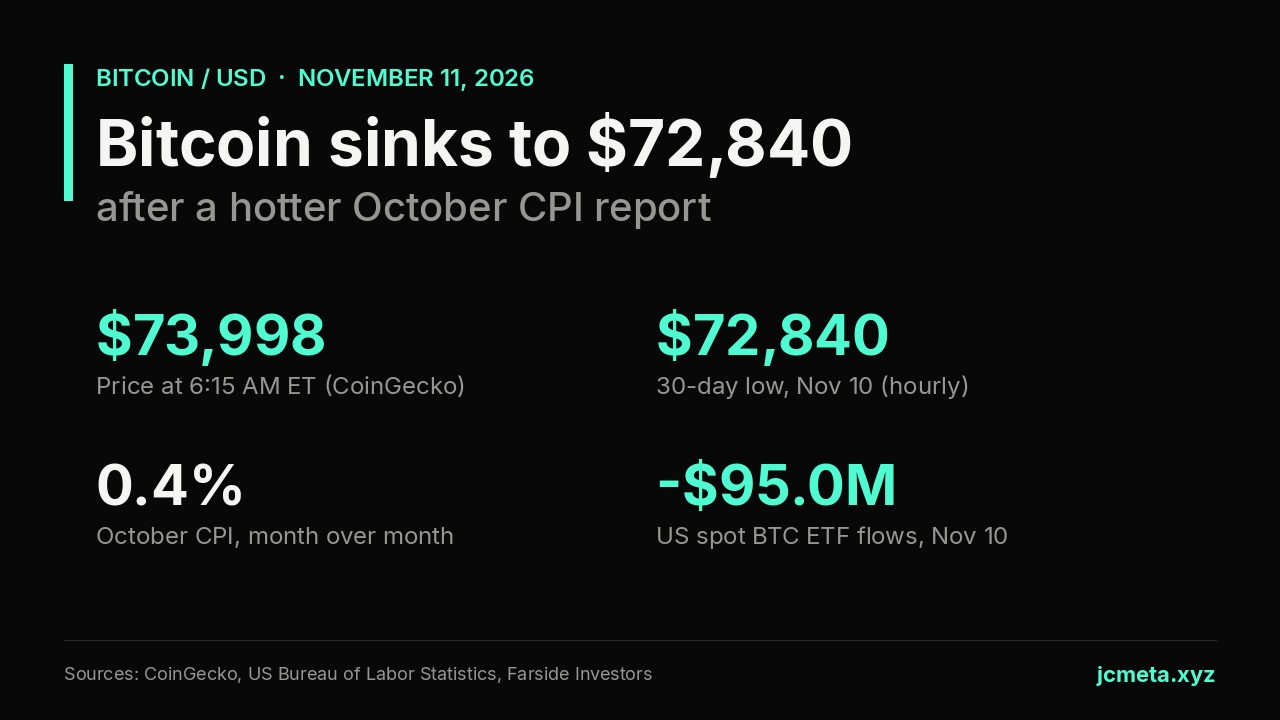
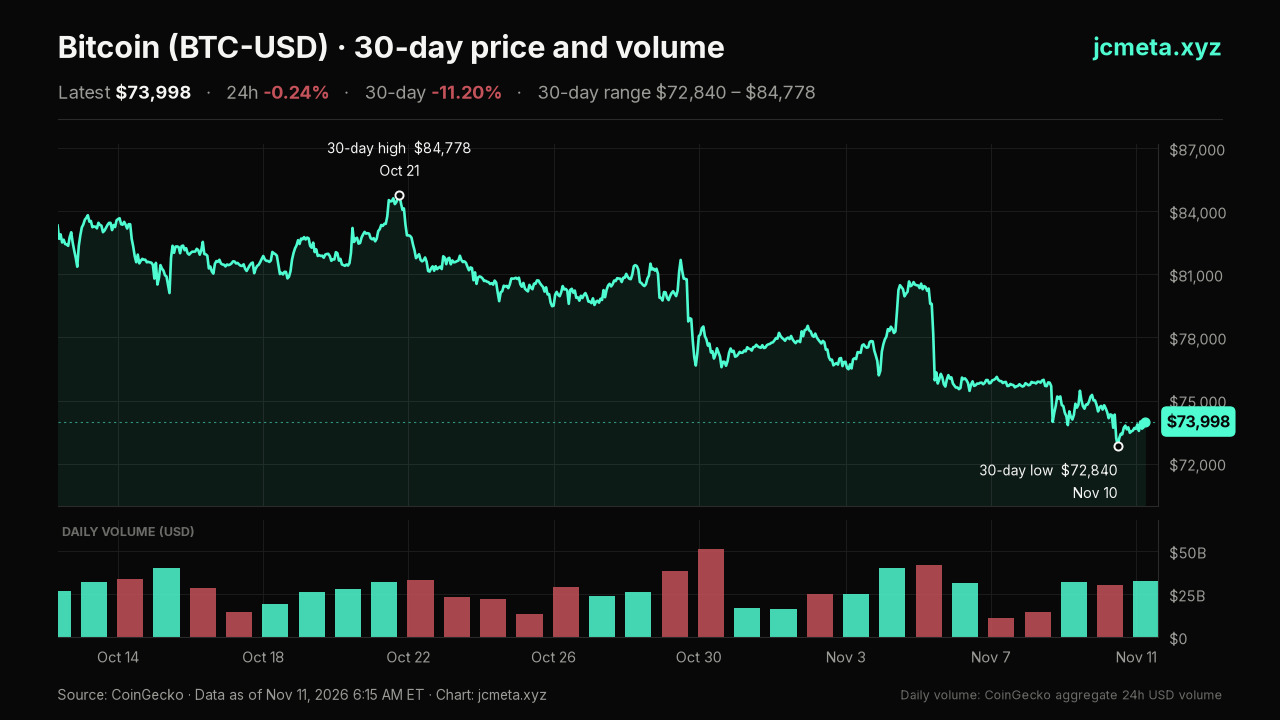
Bitcoin was trading at $73,998 at 6:15 AM ET on Wednesday, according to CoinGecko, down 0.24% from a day earlier and 11.2% below its level 30 days ago. On Tuesday its hourly price touched $72,840, the lowest point in CoinGecko's 30-day data. CoinDesk described the move as bitcoin's weakest level since August 20.
The trigger was a single government release. The Bureau of Labor Statistics said at 8:30 AM ET Tuesday that the consumer price index rose 0.4% in October, after 0.6% in September. Economists had expected 0.3%. Core CPI, which leaves out food and energy, rose 0.3% against a 0.2% forecast, Yahoo Finance reported.
Why did bitcoin fall after the October CPI report?
Because October consumer prices rose 0.4%, above the 0.3% forecast, which pushed Treasury yields higher and firmed up bets on a Federal Reserve rate hike on December 9. Bitcoin fell about 1.2% within minutes of the 8:30 AM ET release, per Yahoo Finance.
The first five minutes after the print were the busiest of the morning. On Coinbase, bitcoin swung between $74,599 and $73,400 in that window and traded about 483 BTC, compared with roughly 36 BTC in the five minutes before it, according to the same Yahoo Finance account.
Bond yields and the December Fed meeting
Rates moved hardest. CoinDesk reported the 10-year Treasury yield up 13 basis points to 4.99% and the two-year yield up 19 basis points to 4.736% during the session. Hours before the data, Fed Governor Christopher Waller said a hotter reading should put a 50-basis-point increase on the table. "Hiking only 25 basis points would put our credibility at risk," he said, as quoted by Bitcoin Magazine.
The report carried no annual inflation rate. The 2025 government shutdown left the agency without October 2025 price data, so there is nothing to compare against.
Leverage paid for the drop. About $200 million in leveraged positions were liquidated in the hour after the report, CoinMarketCap said, citing Coinglass data. Spot bitcoin ETFs kept leaking money as well: a net $95.0 million left on November 10, per Farside Investors. BlackRock's IBIT lost $78.2 million and Fidelity's FBTC $36.8 million, while Morgan Stanley's MSBT took in $20.0 million. That puts November's net outflow at about $1.58 billion through seven sessions.
Key takeaways
- Bitcoin was $73,998 at 6:15 AM ET on November 11, per CoinGecko.
- October CPI rose 0.4% against a 0.3% forecast; core CPI rose 0.3%.
- US spot bitcoin ETFs had net outflows of $95.0 million on November 10, per Farside.
What to watch next
The Fed's December 9 decision is now the main event, and traders are debating its size rather than whether it happens. The next CPI report is scheduled for December 10, the day after. In the nearer term, watch whether the $72,840 low holds and whether IBIT, which has seen outflows on eight straight trading days, posts its first inflow since October 29.