For about 11 weeks this fall, a small team from the AI evaluation nonprofit METR sat inside Anthropic's data. From August 12 to October 29, 2026, its staff reviewed internal benchmark scores, compute figures, staff surveys and around 15 interviews, all to answer one question: is AI now speeding up the work of building AI?
METR's public report, dated November 5, says probably yes. The Associated Press and The Verge picked it up, and it was still circulating among researchers on X through the weekend.
Is AI speeding up AI research at Anthropic?
Likely yes, according to METR. In a November 5, 2026 assessment, the nonprofit estimated that Anthropic is improving its models on well-specified tasks at about twice its March 2024 to October 2025 pace, and guessed that roughly 80% of the current speedup comes from Anthropic's own use of AI.
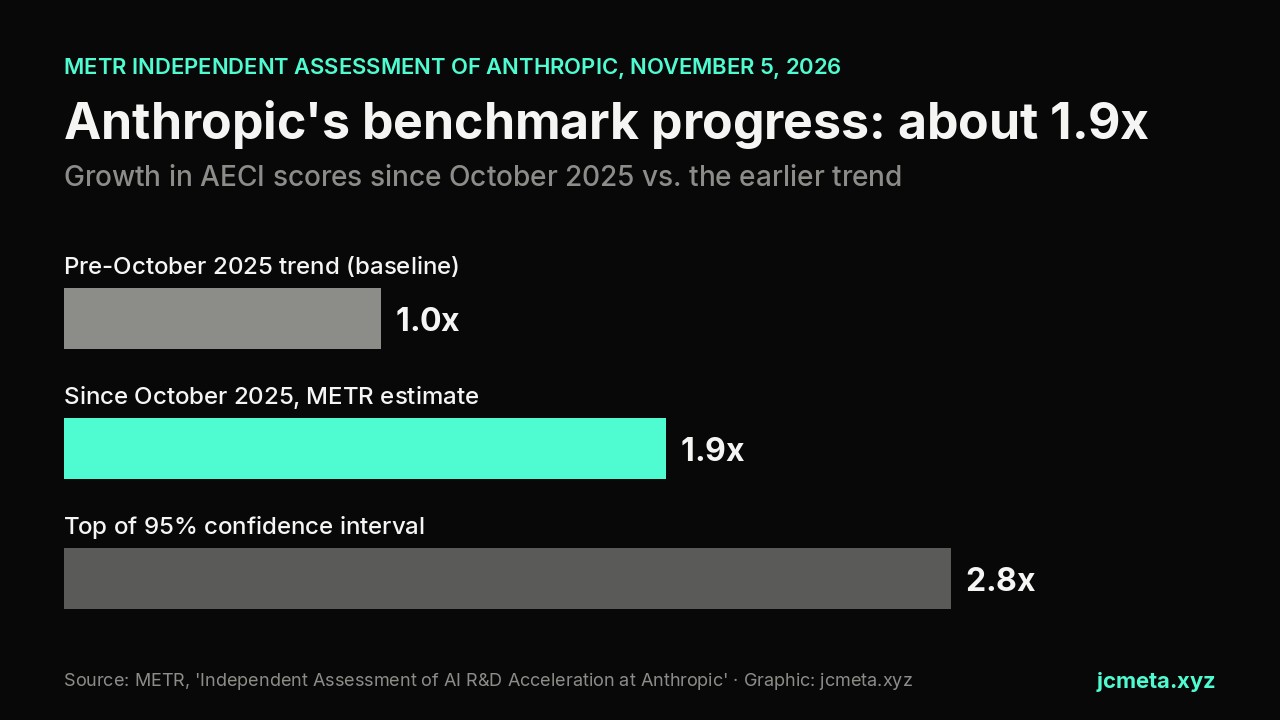
The headline number is 1.9x. Since October 2025, scores on AECI, Anthropic's version of the Epoch Capabilities Index, have grown at about 1.9 times the earlier rate, with a 95% confidence interval of 1.5x to 2.8x. In METR's words, that implies Anthropic "has made roughly two years of historical progress over the last year."
Key takeaways
- METR estimates Anthropic's benchmark progress has run about 1.9x faster since October 2025.
- METR guesses roughly 80% of the October 2026 acceleration is due to Anthropic's use of AI.
- METR says it is confident the speedup did not come from faster growth in training compute.
What the evidence shows, and what was cut
METR ruled out one obvious explanation. It said it was confident the acceleration did not come from faster scaling of training compute. Interviews pointed at Claude instead. Staff self-reported uplift from the newest internal model averaged about 12x in October 2026 Slack polls, a figure METR called "only very loose evidence."
The report also found no clear bottleneck in algorithms, compute or data that would stop progress over the next 12 months. AI is not yet making fully autonomous contributions to the most important parts of training, METR wrote, but researchers described "signs of life."
The limits are spelled out plainly. Anthropic had unilateral redaction rights, and METR says the company redacted a majority of the evidence it found most informative. Anthropic also dropped a planned check of how its compute is split between capabilities and safety work. METR took no payment for the review.
For anyone running a business on these models, the practical point is speed of change: tools are likely to improve faster than annual planning cycles assume. We looked at how that plays out for creators in our guide to the AI content stack, and at the money behind the race in Sunday's piece on OpenAI's $1.25 trillion valuation.
What to watch next
METR says its estimate could be too high or too low, and Anthropic's next system card will show whether its own number moves toward METR's. The Haiku 5.5 system card put the acceleration at 1.7x; METR's higher figure comes mainly from including newer internal-only models.