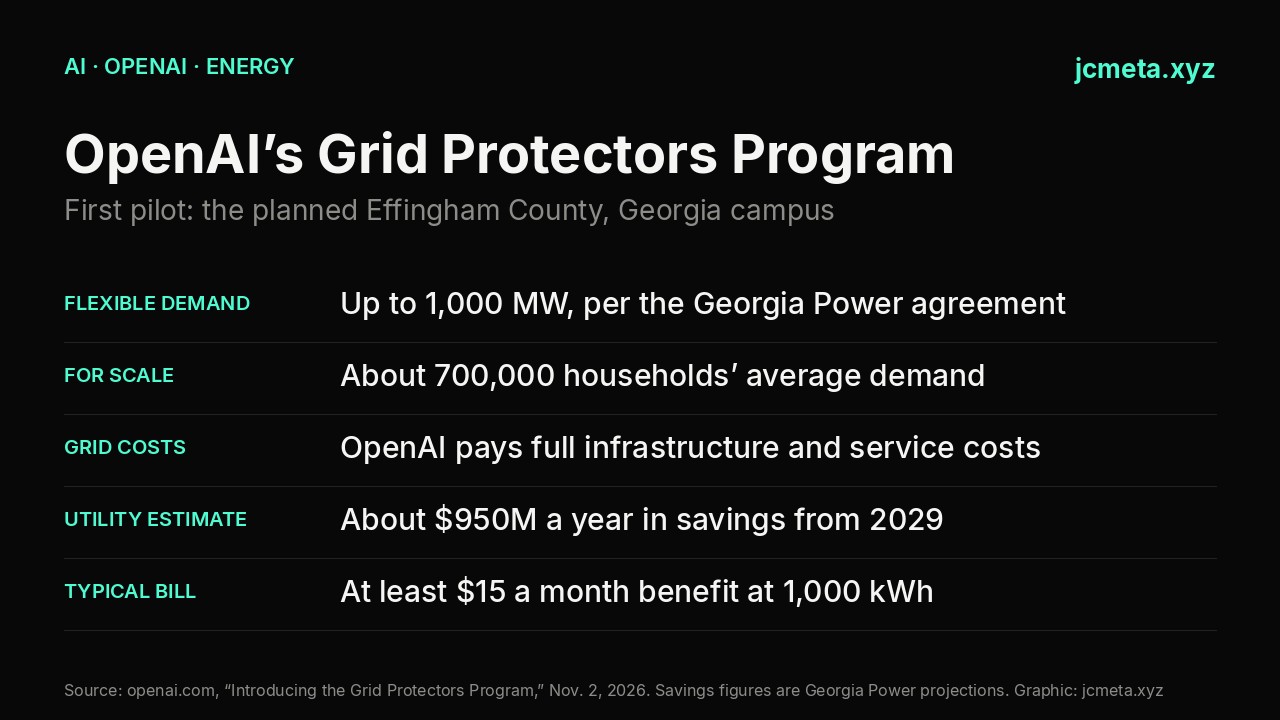
OpenAI wants its data centers to give power back when the grid needs it. In OpenAI’s announcement on Monday, the company launched the Grid Protectors Program and said its planned Georgia campus can cut demand by up to 1,000 megawatts during emergencies such as extreme heat.
That is roughly the average electricity demand of 700,000 households, OpenAI says, or “more households than Washington, D.C., and Boston combined.” The flexibility comes from its existing agreement with Georgia Power for the planned campus in Effingham County, near Savannah.
What is OpenAI’s Grid Protectors Program?
Grid Protectors is a national OpenAI program, launched November 2, 2026, to design its future compute campuses so they can cut electricity use when the local grid is under strain. Its first pilot is a planned campus in Effingham County, Georgia.
In practice, OpenAI says it will work with utilities to agree on how much demand a campus can drop, how quickly and for how long. Depending on the site, it may also supply power from on-site generation or storage, and use batteries and power controls to smooth swings in demand. “The arrangements will differ by location,” the company wrote.

Who pays for the power lines
The cost question sits at the center of the pitch. “Families and small businesses should not be asked to subsidize a compute campus’s electricity needs,” OpenAI wrote. For Effingham, it says it has committed to pay the full infrastructure and electric-service costs required to serve the project.
The argument is that a big, steady customer helps spread a grid’s fixed costs. OpenAI compares itself to the regular diner who keeps a vacation-town restaurant open in the off-season. Georgia Power projects about $950 million in annual customer savings starting in 2029 from its portfolio of large-load agreements and expected growth, which includes OpenAI’s project, and estimates a benefit of at least $15 a month for a typical home using 1,000 kilowatt-hours.
Key takeaways
- OpenAI launched the Grid Protectors Program on November 2, 2026.
- Its planned Effingham County, Georgia campus includes up to 1,000 MW of flexible demand response.
- OpenAI says it will pay the full infrastructure and electric-service costs for that campus.
Why it matters for AI
Power is now the hard limit on AI growth. OpenAI cites projections that U.S. data center capacity will exceed 100 gigawatts by 2030, and local pushback over electricity bills has become one of the main obstacles to new campuses. A promise to turn down during peaks is an attempt to make those projects easier for regulators to approve.
The company was also clear about the limits. “Flexibility cannot replace investment in new energy supply and transmission,” it wrote. For creators and small teams, the link is indirect but real: the price and availability of the AI tools in a modern content stack depend on how fast this compute can be built.
What to watch next
OpenAI says it will share more commitments as site-by-site deals are finalized, so the next test is whether Grid Protectors terms show up at campuses beyond Georgia. The program arrived the same day as OpenAI’s new Abu Dhabi agreements, part of the funding push we covered in Sunday’s story on its $20 billion raise.