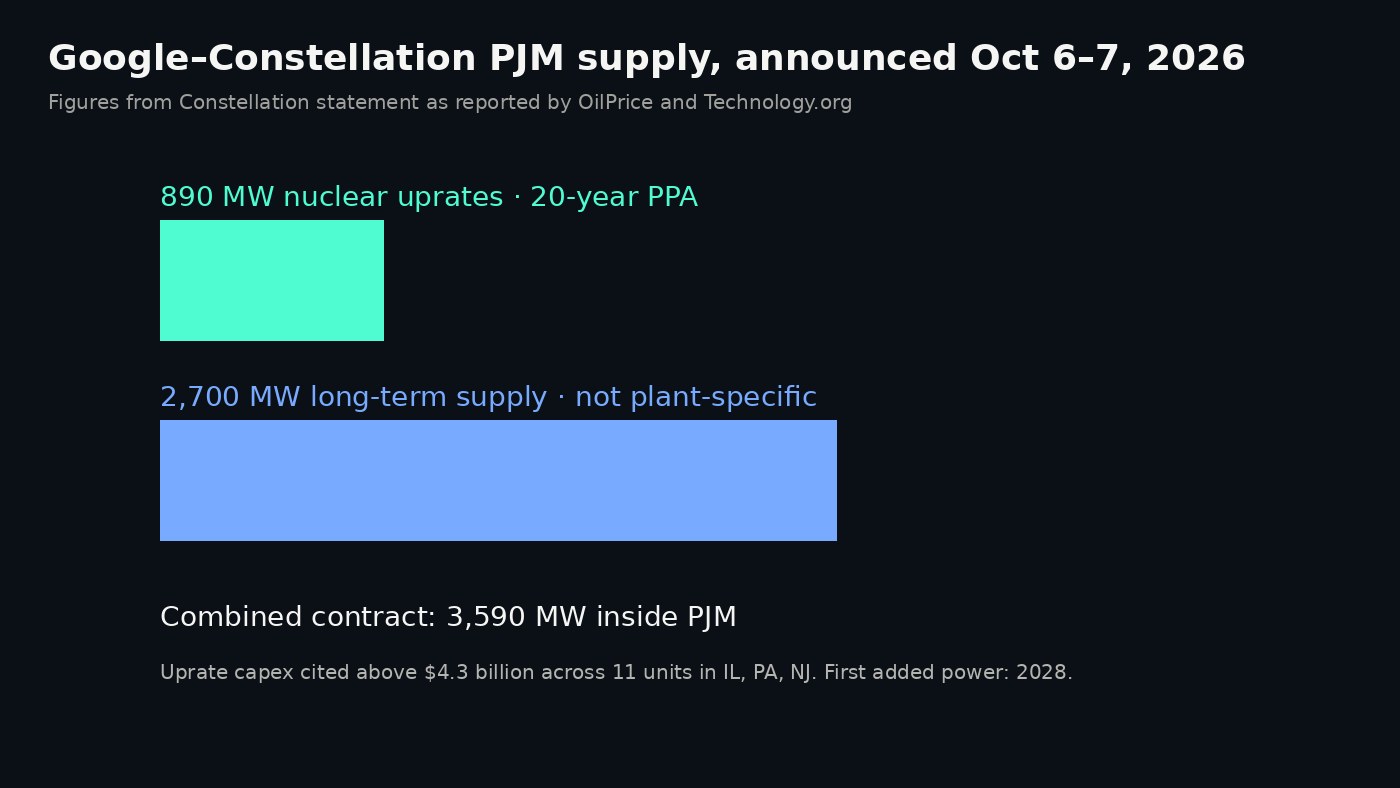
Google contracted 3,590 megawatts of supply from Constellation Energy inside PJM, the grid that covers 13 states and Washington, D.C. About a quarter of that, 890 megawatts, is a 20-year power purchase agreement tied to nuclear uprates. The other 2,700 megawatts is a separate long-term supply deal that is not pinned to a single plant. OilPrice and Technology.org both dated the announcement to October 6, with the write-ups landing October 7.
No new reactor is in the contract. Constellation will add the 890 megawatts by upgrading equipment at 11 units it already runs in Illinois, Pennsylvania, and New Jersey. The company said that work costs more than $4.3 billion. First additional power is expected in 2028. Both firms framed the signing as a response to PJM’s proposal that large data centers bring their own electricity or risk remote curtailment at peak.
The split is the part operators will actually model. The 890 megawatts is firm nuclear output that does not exist yet. The 2,700 megawatts is revenue certainty for Constellation’s operating fleet, not a named turbine. Google’s data-center load is the buyer. That is the same power bill that sits under model training and inference, including the creator tooling covered in How AI is Reshaping the Content Creator Stack in 2026.
Key takeaways
- Google’s Constellation package is 3,590 MW: 890 MW of nuclear uprates under a 20-year PPA, plus 2,700 MW of long-term supply.
- Uprates cover 11 existing units in Illinois, Pennsylvania, and New Jersey, with more than $4.3 billion of cited investment.
- First added megawatts are expected in 2028. No new reactor is part of the deal.
What does Google’s 890 MW nuclear uprate actually add?
An uprate raises the output of a reactor that is already licensed and running. Constellation described new equipment and higher thermal efficiency, not a construction start. The 890 megawatts is therefore incremental firm power on PJM, timed for 2028, not a 2030s greenfield plant. Against a 3,590 megawatt headline, it is 24.8 percent of the contracted total.
The rest of the package is a hedge on who gets served when the grid is tight. PJM has told large loads to show up with generation or accept being switched off. A 20-year nuclear contract is Google’s answer for the slice it can wait until 2028 to receive. The 2,700 megawatt leg is the nearer-term claim on power that already exists.
What to watch next
Whether Constellation files the uprate scope unit by unit, and whether any of the 11 plants slip past 2028. A second number to track is how much of the 2,700 megawatts is delivered from nuclear versus the rest of Constellation’s PJM book. Google has not published a site list for which data centers take the power. Until that list exists, the contract is a grid reservation, not a campus ribbon-cutting.