OpenAI published its text-provenance plan on October 5. API customers worldwide can now opt in to watermarking on select models. The switch stays off unless a customer turns it on. ChatGPT and Codex get a different schedule: an invisible mark on eligible text in the European Union over the coming weeks, not a global default. The post is “Our approach to EU text provenance rules.”
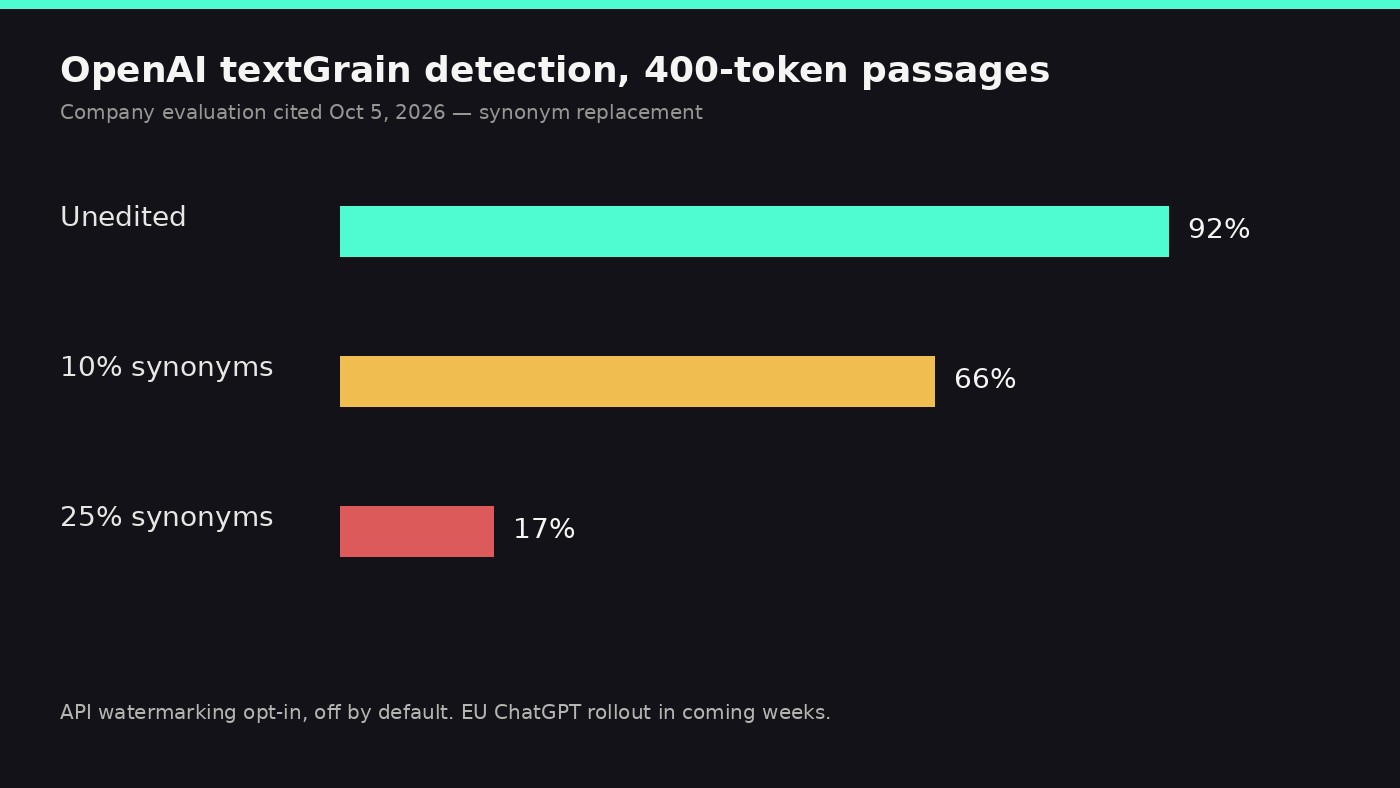
The mark is called textGrain. It is a statistical signal in word choice, not a visible footer. OpenAI’s detector looks for that signal. In a 400-token evaluation cited by 9to5Mac from the company note, detection sat near 92 percent on untouched passages. Replacing 10 percent of words with synonyms cut that to 66 percent. Replacing 25 percent cut it to 17 percent. Detector access starts with approved researchers and expert organizations.
The deadline driving the note is the EU AI Act’s machine-readable marking rule for generated text. OpenAI already publishes image and audio identifiers. Text was the gap. Creators who pipe model output through an editing stack should read the synonym result as the operational number. A light rewrite is enough to weaken the signal. How that sits next to a publishing workflow is covered in How AI is Reshaping the Content Creator Stack in 2026.
Key takeaways
- API text watermarking is opt-in and off by default, for select models, starting October 5.
- EU ChatGPT and Codex text gets an invisible mark over the coming weeks; no global default at launch.
- On 400-token passages, detection fell from about 92 percent to 17 percent after a 25 percent synonym swap.
What does OpenAI’s textGrain watermark actually detect?
A pattern in which words the model preferred, not a tag a reader can see. The detector scores whether a passage carries that pattern. OpenAI said watermarked and unwatermarked outputs showed no meaningful quality gap in its comparison, and watermarked text scored slightly higher on several benchmarks. The fragility is the other finding. A quarter of the words swapped for synonyms dropped detection from the low 90s to the high teens. Anyone pasting ChatGPT copy into a draft and rewriting sentences is already outside the easy-detection band.
The same week produced a separate legal file. TradeSun sued OpenAI in San Francisco federal court on October 5 over the Astra name, case 3:26-cv-11360, according to Reuters. That complaint is about a trademark, not the watermark. OpenAI called the suit meritless. The two items share a date and a defendant. They do not share a product.
What to watch next
Which API models actually accept the opt-in, and when the EU ChatGPT mark lands on free versus paid plans. OpenAI said the regional rollout is meant to collect feedback before any wider default. Detector applications, limited at first to researchers and expert groups, are the other queue.