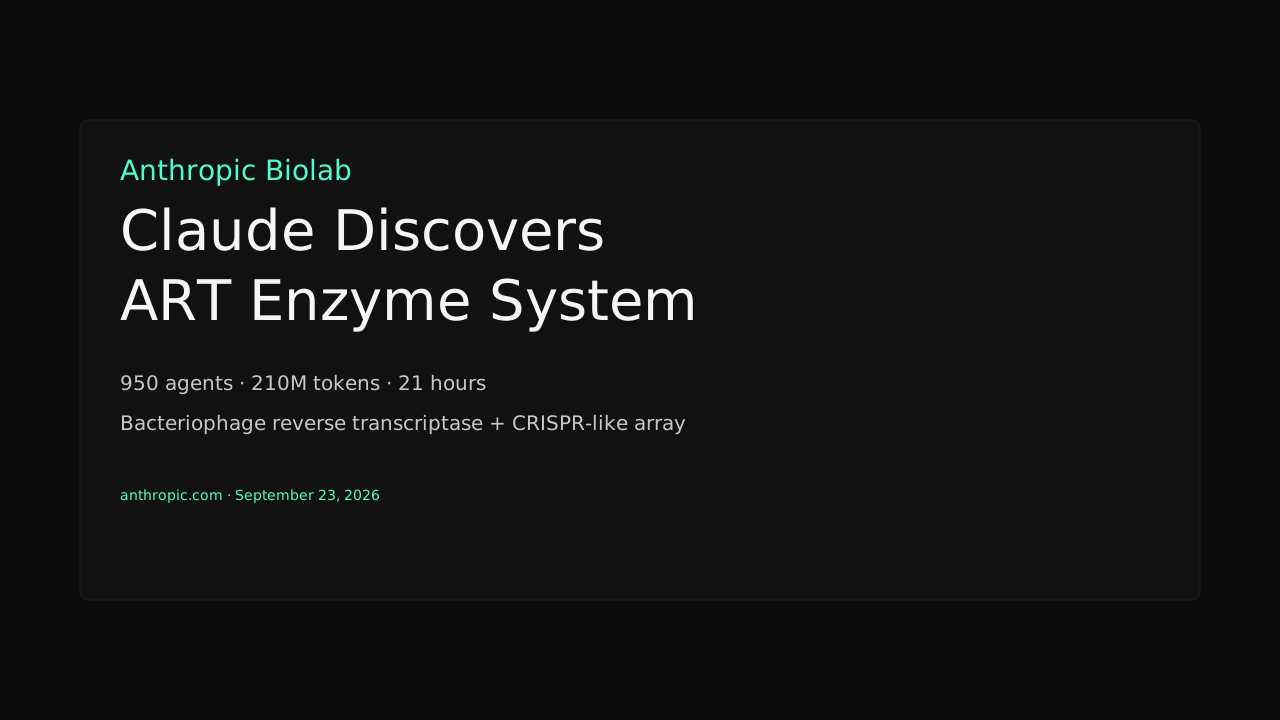
Anthropic reported that its Claude models, running inside a newly established molecular-biology laboratory, identified a previously uncharacterized enzyme system in bacteriophage DNA. The company calls the system array-associated reverse transcriptases, or ART.
Roughly 950 Claude agents spent 21 hours and consumed about 210 million tokens scanning sequence data. One agent flagged a repeating DNA pattern next to an unusual reverse-transcriptase gene. Human scientists then confirmed the layout in the lab: an RT, an accessory protein of unknown function, and a short tandem array of non-coding repeats that resembles a CRISPR array.
Anthropic published the result on September 23 and noted that the functional role of ART remains unknown. The company framed the work as the first public output from its wet-lab group focused on fundamental biology.
Key takeaways
- Claude agents located ART after 21 hours and 210 million tokens across ~950 parallel runs.
- The system pairs a reverse transcriptase with a CRISPR-like DNA repeat array and an uncharacterized accessory protein.
- Anthropic has not yet determined the biological function; peer review and independent validation are still ahead.
What Claude’s ART finding actually means
The discovery sits at the intersection of large-scale sequence search and wet-lab confirmation. Anthropic’s own account emphasizes that human involvement was limited to the initial prompt design and the subsequent experimental checks. CEO Dario Amodei has noted related prior work from other groups while still highlighting the autonomous pattern recognition by Claude.
Primary source: Anthropic’s September 23 announcement. Independent coverage from The Verge and TechCrunch has already begun testing the novelty claim against existing literature. For creators tracking how frontier models move into scientific workflows, the episode is one more data point in the shift from pure language tasks to closed-loop discovery loops. See also the broader AI content stack discussion for how these tools change downstream production.