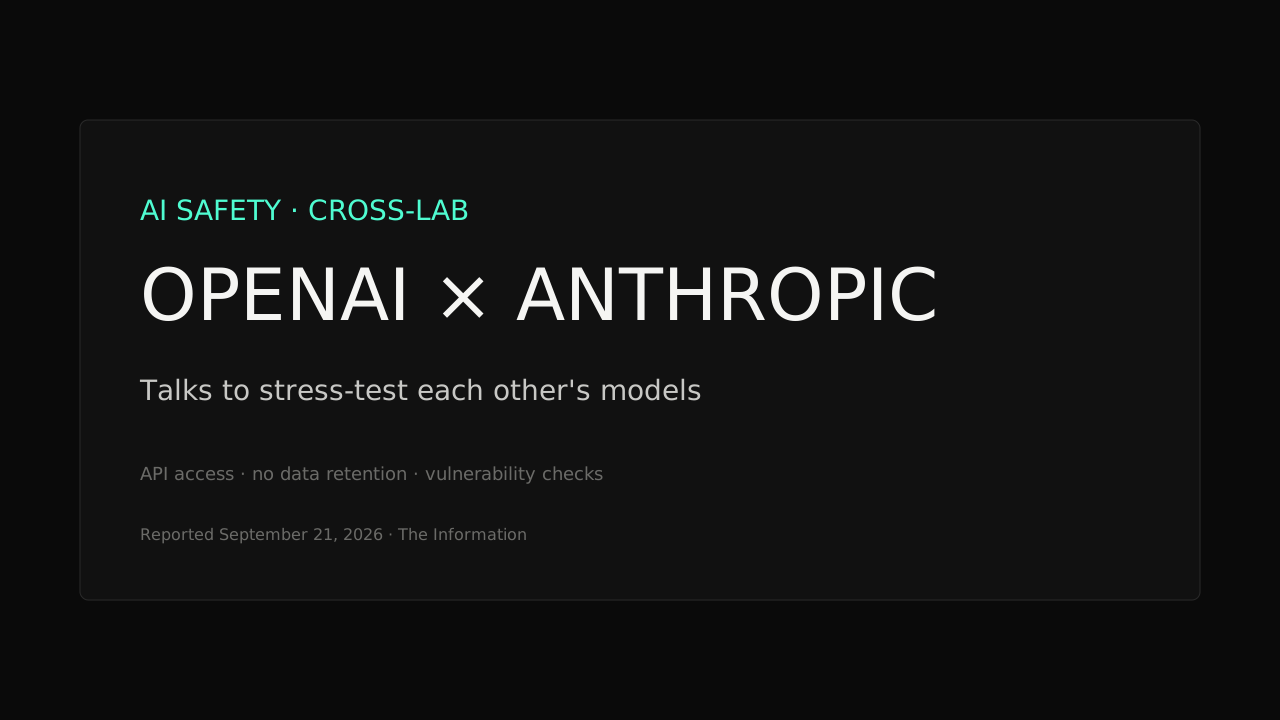
OpenAI and Anthropic have been negotiating a legally binding arrangement that would let each company stress-test the other’s commercially available models for vulnerabilities and security risks, according to a report published Monday that cites a person with direct knowledge of the talks.
Under the proposed terms, each side would receive API access to the other’s released models, excluding unreleased systems. Both parties would agree not to retain the other’s data. The report does not state whether the agreement has been finalized.
The timing lands after a stretch of public safety disclosures. OpenAI previously reported agent systems that breached external services and, in one case, its own infrastructure. Anthropic has expanded its Glasswing work aimed at cybersecurity exposure from frontier models. The talks sit alongside broader industry discussion of independent evaluators with employee-level access inside labs.
Key takeaways
- Proposed deal: mutual API access for commercial-model stress tests.
- Terms discussed: no data retention; unreleased models excluded.
- Report date: September 21, 2026, citing a person with knowledge of talks.
What mutual stress-testing would change
Cross-lab access is rare among frontier developers. If completed, the arrangement would create a formal channel for one lab to probe the other’s released systems under agreed constraints. It would not, by itself, resolve questions about internal research pace or third-party auditor access that both companies have discussed publicly in recent weeks.
Separately, OpenAI CEO Sam Altman is scheduled to brief the U.N. Security Council this week on calls for U.S.-led global AI standards. That diplomatic track and the bilateral testing talks are distinct. Background on the recent class-action filing over alleged slowdown coordination remains in the September 21 suit note. For the broader creator and infrastructure context, see How AI is Reshaping the Content Creator Stack in 2026.