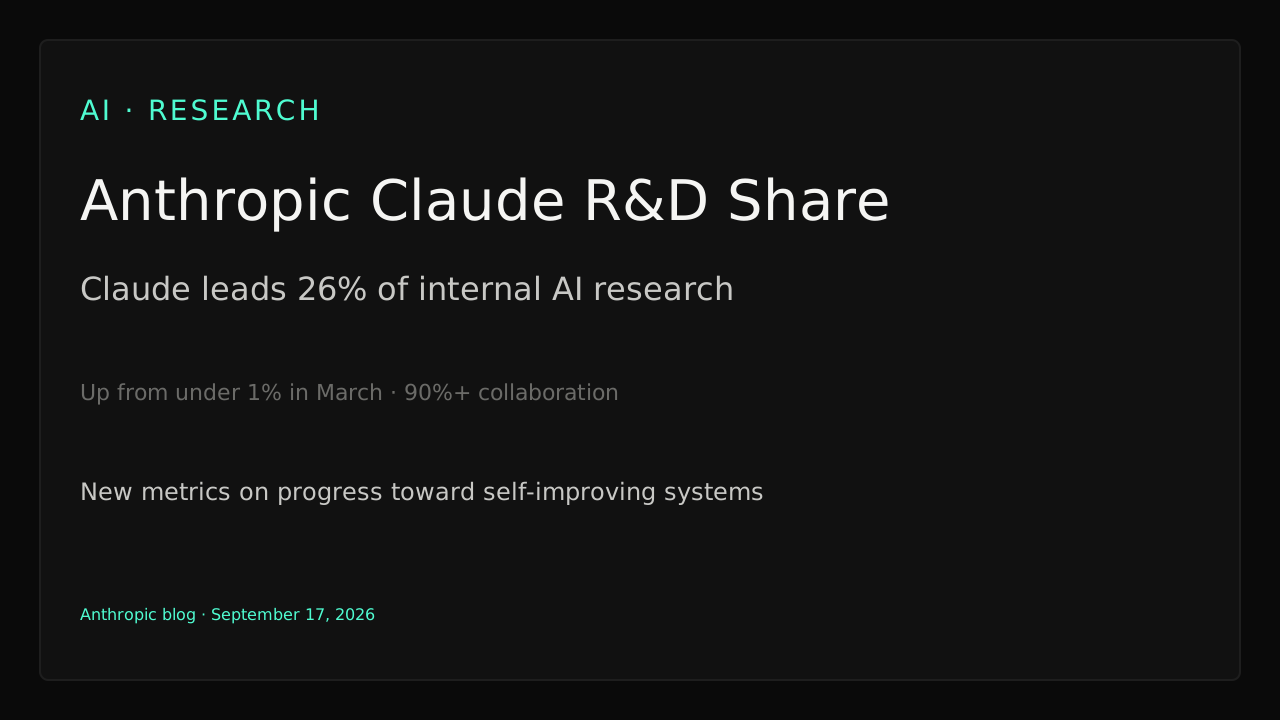
Anthropic published new internal metrics on Thursday showing that its Claude model now “leads” 26 percent of the company’s artificial-intelligence research and development work. The share stood below 1 percent in March. Collaboration between Claude and human researchers exceeded 90 percent of measured R&D tasks as of August.
The company defined “leads” as the model completing most of a task end-to-end from a high-level prompt while remaining under human supervision. Claude is not operating fully autonomously in any measured subset of the work. Anthropic framed the numbers as a public window into how close the industry sits to recursive self-improvement—systems that can build their own successors with limited human input.
The disclosure arrives amid broader industry discussion of frontier-model pace, including earlier coordination among Anthropic, OpenAI and Google DeepMind on safety measures. Cross-reference the safety-talks coverage at the September 16 piece and the OpenAI misalignment framework at the September 17 disclosure.
Key takeaways
- Claude leads 26% of Anthropic’s AI R&D, up from under 1% in March.
- Human–AI collaboration covers more than 90% of measured research work.
- Anthropic will publish the metrics regularly to track progress toward self-improving systems.
What the 26 percent figure actually measures
Primary source material is Anthropic’s own blog post. The scale draws on methodology developed with Epoch AI, an independent nonprofit that tracks AI capabilities. Roughly 30,000 agents were performing research and engineering work inside the company as of August. Every agent action is screened before execution; about one in 47,000 decisions was blocked in the measured period.
In a sample week in July, about 6 percent of Anthropic’s research compute went to safety work, rising to 12 percent for research carried out by AI itself. The company reiterated plans to embed third-party evaluators with access comparable to internal staff.
What to watch next
Whether other frontier labs adopt comparable public R&D-share metrics will determine if the numbers become an industry benchmark. Watch the next scheduled update from Anthropic and any parallel disclosures from OpenAI or Google DeepMind on the contribution of their own models to internal research.